INNOVACCER / PATIENT 360

Redesigning risk coding for providers and medical coders

Redesigning risk coding for providers and medical coders

OVERVIEW

When a doctor sees a patient, they document diagnoses, prescriptions, and clinical notes. A medical coder then reviews these records to check if everything was captured – because what's not documented means lost funding and incomplete care history.

The problem: the doctor and the coder use different tools. The doctor documents in InNote during the visit. The coder reviews in Patient 360 after. Neither has complete visibility into what the other has done.

My challenge: connect these two workflows so the coder's review is informed by what the doctor already documented closing the loop across both products.

MY ROLE

I owned Patient 360's (product housing patient records) risk adjustment experience – driving improvements across the workflow over time and adding new features like an AI Agent, query template management, provider response visibility, and more – as I cross-collaborated with the InNote product and design team.

IMPACT

Review time reduced from ~15 min to under 5 min for 79% of users. 146K+ coding gaps reviewed across 30+ health systems.

TEAM

2 Senior product managers, Engineering team · Cross-collaboration with the InNote product and design team

TIMELINE

April 2024 - Feb 2025

TIMELINE

April 2024 - Feb 2025

What the healthcare environment looks like..

Healthcare runs on three players. Providers, Patients & Payers (insurance). The link between all three is documentation (prescriptions, visit notes, discharge summaries, diagnoses, etc) - what the doctor writes down during a visit.

Two tools. Same patient. No shared view.

Doctors document what a patient has – eg. diabetes, heart failure, COPD – into an EHR (Electronic Health Record) during visits. Insurance reimburses hospitals based on what's documented – if a condition isn't in the record, the hospital doesn't get paid for treating it.

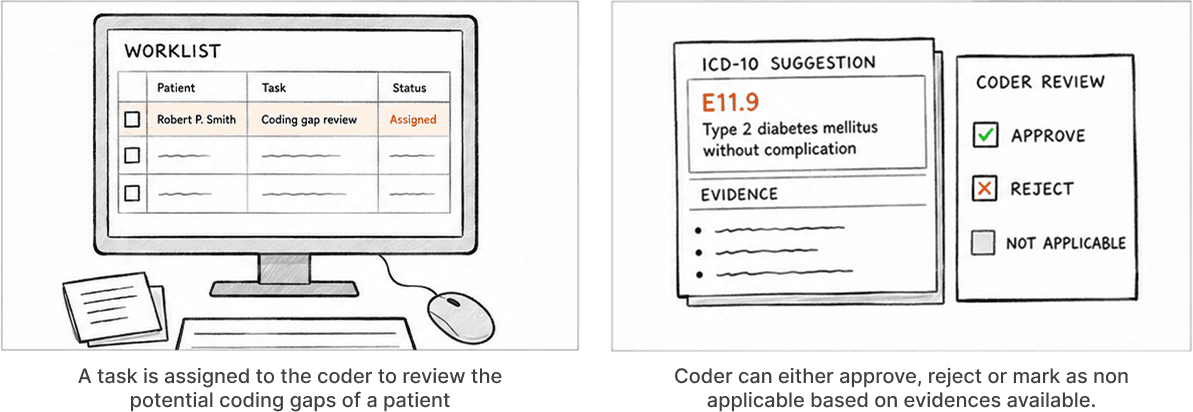
P360 surfaces conditions a patient is known to have or is suspected to have and represents them as standardised codes. A medical coder reviews these conditions and decides - approve, or reject based on the evidences available from the documentation.

But the doctor works in a separate app called InNote. What they've already documented during the visit never made it into the coder's view.

How might we bring the doctor's decisions and documentation into the coder's review, without either of them switching tools?

The workflow existed. Just not in the product.

4 sessions with 3 coders, customer calls, SME interviews, and a Mixpanel audit gave us a clear picture.

"I'm not gonna be working on that claim until I get a response back from the query."

"Don't categorize codes - providers don't care about HCC and ICD-10 codes"

Insights from interviews

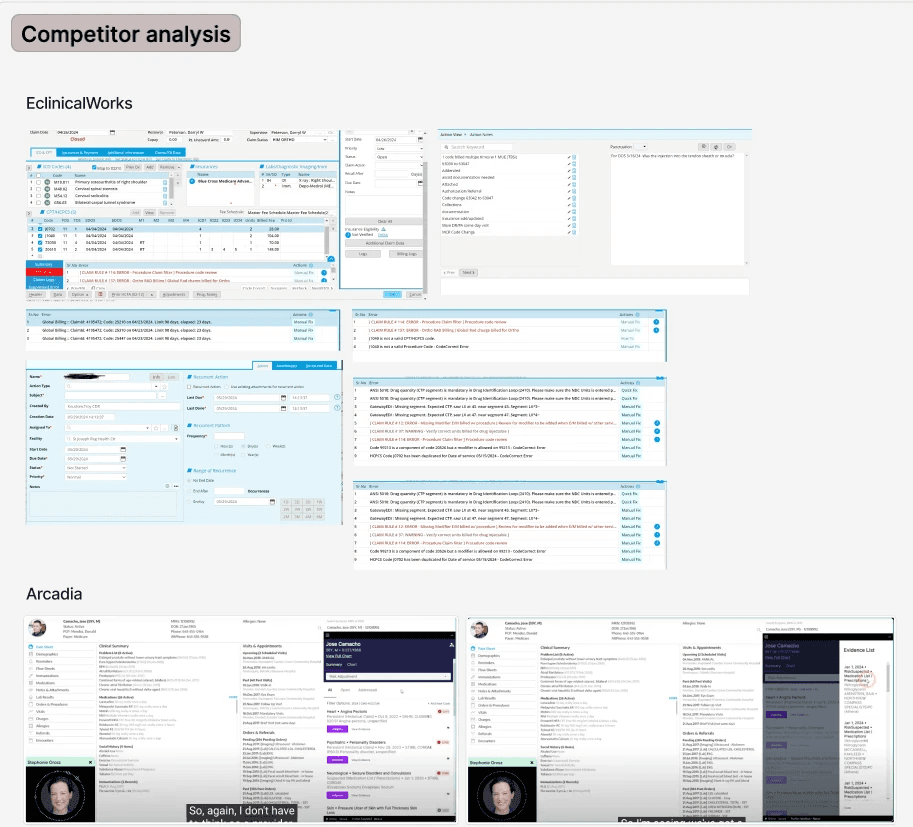
Coders were already doing the collaborative review manually. Toggling apps, copy-pasting from emails, tracking queries in spreadsheets.

Multiple customers flagged that documentation clarification queries were inconsistent. Some had built offline templates to try and standardise things themselves.

P360 spoke in standardised codes, doctors spoke in disease names. The product was forcing a translation layer on every interaction.

The coder saw a label, not the story. Provider actions were visible - but not their notes, reasoning, or documentation details.

"I'm not gonna be working on that claim until I get a response back from the query."

"Don't categorize codes - providers don't care about HCC and ICD-10 codes"

Insights from interviews

Coders were already doing the collaborative review manually. Toggling apps, copy-pasting from emails, tracking queries in spreadsheets.

Multiple customers flagged that documentation clarification queries were inconsistent. Some had built offline templates to try and standardise things themselves.

P360 spoke in billing codes, doctors spoke in disease names. The product was forcing a translation layer on every interaction.

The coder saw a label, not the story. Provider actions were visible - but not their notes, reasoning, or documentation details.

Some snippets from our research

Some snippets from our research

Connecting coder and doctor

Coders only see a task when there's something actionable - any flagged conditions, and a doctor's response already in after an appointment.

Worklist tasks

The coder can now see what the doctor documented after the visit - their decision on the condition, any notes they added, and the supporting evidence they referenced.

Provider responses at code level

When a coder needs the doctor's input on a condition, they raise a query. Admins set the template, coders pick from it. One query per condition, clear and focused.

Template driven queries

Reorganised the naming convention from standardised billing codes to disease names, like "COPD" instead of "HCC 280." So coders and doctors speak the same language.

Disease names as the primary structure

AI that reviews before the coder does

We introduced a Clinical Documentation Improvement Agent that pre-reviews codes before the coder opens them - reading the same evidence panel the coder would, and surfacing a recommendation with its reasoning.

The agent reads the evidence panel - claims, labs, medications, prior history - and takes an action: approve or reject with valid reasoning.

Reviews codes and reasons

The agent drafts the query on the coder's behalf using evidence already available in the patient's chart. The coder reviews, edits, and sends.

Drafts queries

The agent scans clinical documents and surfaces the relevant evidence for each flagged condition.

Auto-fetches evidence from documents

From blind spot to full picture
BEFORE VISIT
DURING VISIT
BEFORE VISIT
DURING VISIT
AFTER VISIT

Connecting coder and doctor

Coders only see a task when there's something actionable - any flagged conditions, and a doctor's response already in after an appointment.

Worklist tasks

The coder can now see what the doctor documented after the visit - their decision on the condition, any notes they added, and the supporting evidence they referenced.

Provider responses at code level

When a coder needs the doctor's input on a condition, they raise a query. Admins set the template, coders pick from it. One query per condition, clear and focused.

Template driven queries

Reorganised the naming convention from standardised billing codes to disease names, like "COPD" instead of "HCC 280." So coders and doctors speak the same language.

Disease names as the primary structure

AI that reviews before the coder does

We introduced a Clinical Documentation Improvement Agent that pre-reviews codes before the coder opens them - reading the same evidence panel the coder would, and surfacing a recommendation with its reasoning.

The agent reads the evidence panel - claims, labs, medications, prior history - and takes an action: approve or reject with valid reasoning.

Reviews codes and reasons

The agent drafts the query on the coder's behalf using evidence already available in the patient's chart. The coder reviews, edits, and sends.

Drafts queries

The agent scans clinical documents and surfaces the relevant evidence for each flagged condition.

Auto-fetches evidence from documents

Connecting coder and doctor

Worklist tasks

Coders only see a task when there's something actionable - any flagged conditions, and a doctor's response already in after an appointment.

Provider responses at code level

Template driven queries

Disease names as the primary structure

AI that reviews before the coder does

We introduced a Clinical Documentation Improvement Agent that pre-reviews codes before the coder opens them - reading the same evidence panel the coder would, and surfacing a recommendation with its reasoning.

Reviews codes and reasons

The agent reads the evidence panel - claims, labs, medications, prior history - and takes an action: approve or reject with valid reasoning.

Drafts queries

Auto-fetches evidence from documents

What challenged and shaped me

Cross-team collaboration: I owned P360, another designer owned InNote. Every feature touched both systems - which meant aligning with stakeholders across two product and engineering teams. We ran joint sessions, working through workflows, edge cases, and status mappings together instead of through handoff docs.

AI needs to build trust. In a domain like healthcare, fully automating clinical decisions isn't an option, human judgment is essential. Coders were uncomfortable with AI making decisions on codes, so we repositioned our Agent as a reviewer that assisted them instead.

Changing the IA without breaking habits. Years of muscle memory around billing codes and workflow meant transitioning in a way without changing the structure too much. We validated the new information architecture with SMEs across multiple rounds, ensuring the transition felt familiar even as the underlying organisation changed.

Constraints shaped the product. Decisions like limiting queries to one per code, making templates mandatory, and defining task triggers weren't handed to me - they came out of research and design exploration, and I helped shape them alongside the PMs.

Stakeholder mapping is crucial before starting. Identifying and aligning with the right people early - SMEs, users, PMs, engineering leads - set the foundation for our research, validation rounds, and feedback loops throughout the project.

Shipped and adopted at scale

146K+ coding gaps reviewed in one year

146K+ coding gaps reviewed in one year

~15 min to under 5 min for 79% of users.

~15 min to under 5 min for 79% of users.

Adopted by 30+ customers